
Informal Power in Organisations: Why the org chart doesn’t tell the full story
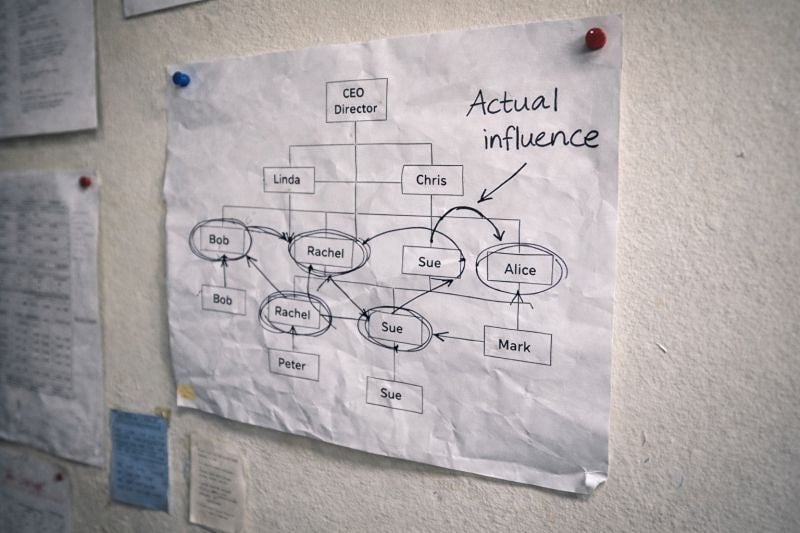
Informal power in organisations often has more impact than formal structure.

On paper, everything looks clear.
roles are defined
titles are assigned
reporting lines are mapped
It looks structured... Orderly... Easy to follow.
But that is not how work actually happens.
This post is the fourth in a short blog series on 'culture repair'.
The limits of the org chart
An org chart shows formal authority.
It tells you:
who reports to who
who has decision rights
where accountability sits
What it does not show is influence.
And influence is what shapes behaviour day to day.
Where influence actually sits
If you want to understand informal power in organisations, watch what people do.
Notice:
who people speak to before decisions are made
who they sense-check ideas with
who they hesitate to challenge
It is rarely just the person with the highest title. Influence tends to sit in:
small, trusted groups
long-standing relationships
individuals with credibility or experience
the people others choose to listen to
This network operates alongside the formal structure. Sometimes it aligns with it. Often, it does not.
What you see in meetings
Meetings make informal power visible.
You will often notice:
some voices carry weight immediately
others have to work to be heard
some people stay silent
These patterns are not random. They reflect where influence sits.
And everyone in the room is paying attention.

How people adapt to informal power
People quickly learn how influence works in their team.
They notice:
who gets agreement
who gets ignored
who gets challenged
who does not
Then they adapt.
You see behaviours like:
going to influential individuals before meetings
testing ideas informally
avoiding direct challenge
using relationships to get things done
Work flows through the network.
Not just the structure.
Why this matters
Informal power in organisations shapes:
decision making
communication
accountability
inclusion and exclusion
If you ignore it, you miss how the system actually operates.
The gap between formal and informal systems
In many organisations, there is a gap between:
The formal hierarchy
The informal network of influence
The formal structure shows how things should work.
The informal system shows how they do work. When these are misaligned:
decisions may not follow formal routes;
some individuals have disproportionate influence;
others struggle to be heard.
This creates inconsistency and frustration.
Why structure changes are not always the answer
Organisations often try to fix problems by changing structure.
They:
re-draw reporting lines;
create new roles;
announce new ways of working.
But the same issues often reappear.
Why?
Because the informal system has not changed.
Influence is built, not assigned
You can assign a role. You cannot assign influence.
Influence is built through:
relationships;
credibility;
trust;
experience;
visibility.
This takes time. And it does not reset when the org chart changes.
What gets missed
When organisations focus only on structure, they miss:
Who really shapes decisions
How information flows
Where resistance sits
Why change does not stick
They design for the formal system.
But people operate within the informal one.
What to pay attention to
If you want to understand informal power in organisations, look beyond titles.
Ask:
who do people go to for advice?
whose opinion carries weight?
who influences decisions behind the scenes?
who is consistently left out?
These questions reveal the real dynamics.
Working with informal power
You cannot remove informal power. But you can work with it.
This means:
recognising key influencers;
understanding relationship networks;
involving informal leaders in change;
addressing imbalances in voice and influence.
Ignoring it creates blind spots.
Final Thought
The org chart tells you how the organisation is designed.
Informal power in organisations tells you how it actually works.
If you want to understand behaviour, decisions, and culture, you have to look at both.
Because influence rarely sits neatly on an org chart.
In the next post in this series I'll be looking at psychological safety at work and how this often impacts people's willingness to speak up.
Nicole Williams is an occupational and coaching psychologist specialising in culture repair, team dynamics and psychologically safe workplaces.
Comments