
Is workplace conflict affecting your business?
Don't let a difficult team become an expensive problem
CONFLICT. CLIQUES. EXCLUSION. MISTRUST. COMPLAINTS.
When workplace conflict and difficult team dynamics begin to affect relationships, trust and performance, it can be hard to know what’s really going on, or how to address it effectively.
I help organisations understand what’s driving difficult team dynamics and intervene at the right level, before the problem becomes more entrenched, and more costly.
£28.5bn
Annual cost of UK workplace conflict
£1,000+
Cost per employee (Source: ACAS 2024)

Are you seeing the warning signs?
Sometimes team conflict is a recognised problem. Sometimes the signs are much more subtle.
People are taking sides
Cliques or factions are developing. People are aligning themselves with particular colleagues or leaders, and relationships are becoming increasingly polarised
The same problems keep returning
You’ve tried conversations, mediation, coaching, team development or HR interventions, but the underlying difficulties haven’t really gone away.
The atmosphere has changed
People are guarded, avoiding conversations, withdrawing from colleagues or becoming reluctant to speak openly.
Good people are being affected
You’re beginning to see an impact on morale, wellbeing, performance, attendance or retention.
You're hearing different versions of events
There are competing accounts of what’s happening and it’s becoming increasingly difficult to know what, or who, to believe.
Things are becoming more formal
Complaints, grievances, disciplinaries or other employee-relations processes are beginning to emerge, and you’re concerned about where the situation could end up.
Often, what you can see is only the surface of the problem.
What's really going on beneath the surface?
What you might see
CONFLICT
COMPLAINTS
SICKNESS ABSENCE
TURNOVER
POOR BEHAVIOUR
GRIEVANCES
PERFORMANCE PROBLEMS
COMMUNICATION BREAKDOWN

What may be sitting underneath
CLIQUES AND INFORMAL POWER
PSYCHOLOGICAL SAFETY
EXCLUSION
LEADERSHIP DYNAMICS
UNSPOKEN NORMS
HISTORIC RELATIONSHIPS
LOW TRUST
ORGANISATIONAL PRESSURES
Don't just treat the symptoms
HR processes may be necessary
Mediation can help
Coaching can help
Team development can help
But difficult team dynamics are rarely explained by one factor alone.
My approach...
I look beneath the presenting problem to understand the interaction between people, relationships, group dynamics, leadership and the wider organisational environment.
This allows us to...
Move beyond what is happening and begin to understand:
why it is happening, what may be maintaining it and what needs to change.
It rarely gets better on its own
It can be tempting to hope that relationships will settle down, people will move on or the situation will resolve itself.
But unresolved conflict can spread beyond the original issue, causing:
Tension
Conflict
Reduced motivation
Lower productivity
Increased absence
Staff turnover
Formal processes
Organisational & legal risk
Among employees experiencing workplace conflict:
Resigned
Reported stress, anxiety or depression
Reduced motivation or commitment,
Reduced productivity
Source: ACAS (November 2025)
The question isn't only:
“What will it cost us to address this?”
It's also:
“What could it cost us if we don’t?”

What level of support does your team need?

Not all difficult teams need a full culture deep dive.
It depends on what’s happening, how far it has developed, how complex the situation is and what has already been tried.
That’s why I offer different levels of support:
01 - NAVIGATE: Team Culture Advisory
02 - UNDERSTAND: Team Culture Deep Dive
03 - DIAGNOSE: Service and Organisation Culture Deep Dive
04 - REPAIR: Culture Repair
Select the tabs below to learn more about each:
01 - NAVIGATE
Team Culture Advisory
“I’m responsible for dealing with this and need help working out what to do."
Focused psychological coaching and advisory support for business owners, managers and senior leaders trying to navigate a difficult team situation. We can explore what you’re seeing, make sense of the dynamics, consider the risks and work through your options for responding.
This could be right for you if:
you're unsure how to tackle a difficult team situation
you’re worried about making things worse
HR processes are happening alongside the wider team problem
HR processes are happening alongside the wider team problem you want an independent psychological perspective
you’re a smaller organisation and a full diagnostic isn’t proportionate
you want support while you attempt to repair the situation yourself.
Available as a single focused session or short advisory programme.
02 - UNDERSTAND
Team Culture Deep Dive
“We know there’s a problem, but we don’t really understand what’s driving it.”
When different people have different accounts of what’s happening, relying on one person's perspective is no longer enough. I independently explore the experiences of the team to identify the patterns, relationships and conditions underlying the difficulties.
Depending on the situation, this may include confidential interviews, focus groups, relevant organisational information, observation and other diagnostic methods. The aim isn't simply to collect opinions.
It is to answer:
What is happening? Why is it happening? What is maintaining it? What needs to change?
03 - DIAGNOSE
Service & Organisation Culture Deep Dive
“This is bigger than one relationship or one team.”
Some cultural problems span multiple teams, professions, locations or leadership levels.
A broader diagnostic allows us to understand where experiences differ, where patterns repeat and which organisational conditions may be contributing to the problem.
The scope is designed around the organisation rather than an arbitrary number of interviews or focus groups. It may involve multiple stakeholder groups, leadership perspectives, quantitative and qualitative evidence and examination of the wider organisational context.
You receive a clear psychological formulation of the problem and practical recommendations for what happens next.
04 - REPAIR
Culture Repair
“We understand what’s wrong. Now we need to change it.”
Diagnosis is only useful if something changes as a result.
Once we understand what is driving and maintaining the problem, I can work with you to design targeted interventions around what the evidence tells us the team or organisation actually needs.
That might involve leadership work, facilitated team interventions, behavioural agreements, rebuilding psychological safety, addressing group dynamics, coaching, structural changes or wider organisational action.
There is no generic culture programme.
Diagnose first. Intervene second.
Not quite ready to talk to us yet?
Watch our webinar: "Navigating Toxic Teams" or Take the free Culture Health Check

Why are some team problems so difficult to resolve?
In this webinar we explore the psychology behind toxic and dysfunctional team dynamics, why conventional attempts to address them don’t always work, and what leaders need to consider when deciding how to intervene.
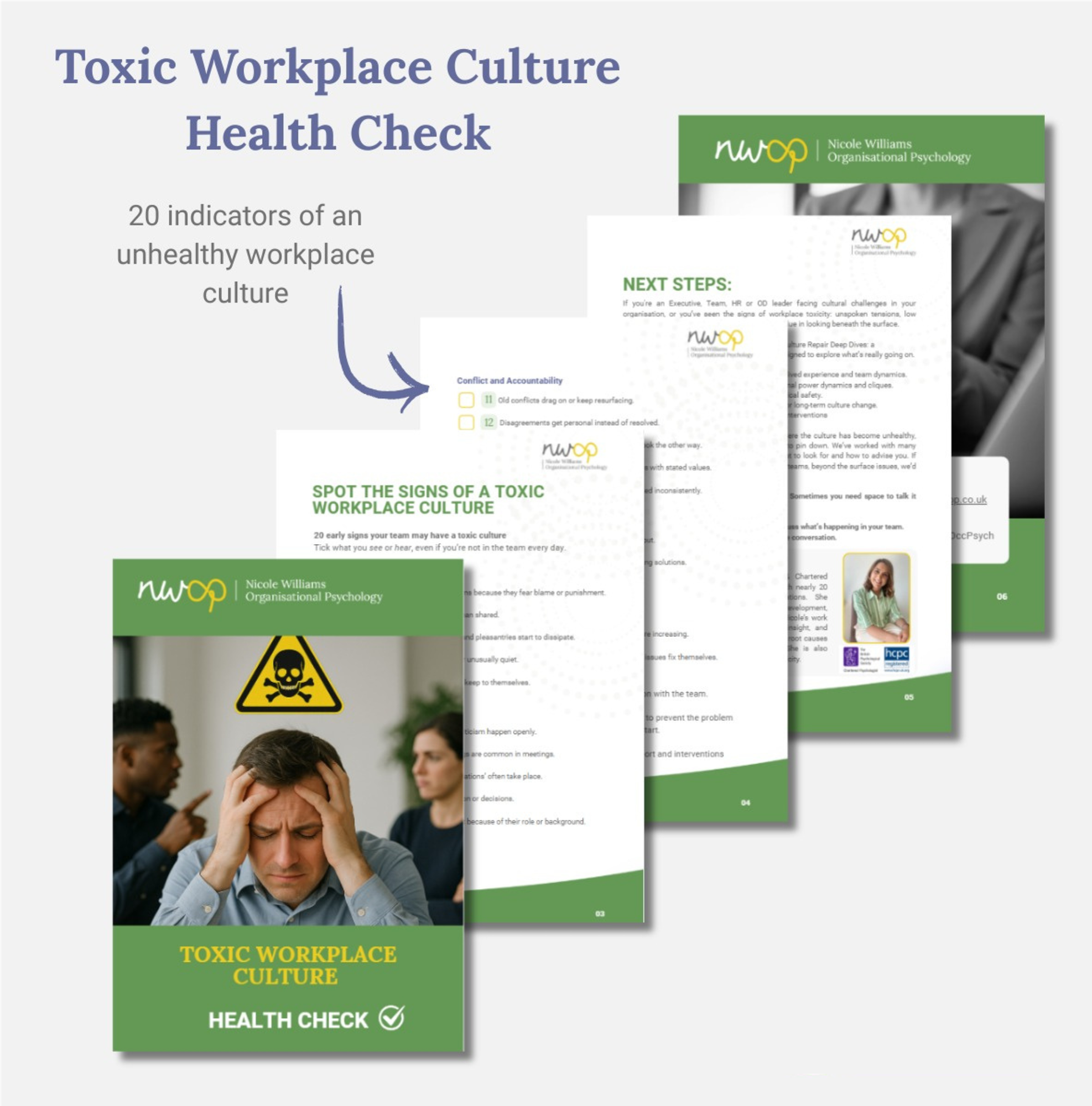
How healthy is your team culture?
You know something isn’t right. But is it normal workplace tension or a sign of something more significant?
My free Culture Health Check helps you take a step back and look at some of the key warning signs.
See what a Culture Deep Dive looks like in practice

When the presenting problem wasn't the whole problem
Maternity Culture Diagnostic
A maternity service was experiencing significant cultural and team difficulties.
Through an independent diagnostic involving around 45 staff, I explored people's experiences and looked beyond the presenting issues to understand the wider patterns and dynamics contributing to the situation.
The diagnostic provided leaders with a clearer understanding of what was happening, what was driving it and where intervention needed to focus.
How I work

Discover
Listen to the people experiencing the culture and gather the evidence needed to understand the situation.
Diagnose
Identify patterns across behaviour, relationships, leadership, group dynamics and organisational conditions.
Formulate
Bring the evidence together through a psychological lens to explain what is happening, why it may be happening and what is maintaining it.
Feedback
Translate complex findings into a clear, constructive account of what needs attention.
Repair
Develop proportionate interventions based on the diagnosis rather than jumping straight to a predetermined solution.
The difference is in the formulation.
Many organisations already have engagement surveys, employee data and individual accounts of what's happening.
The challenge is often understanding what it all means.
My role is to connect those pieces and help you understand the psychological and organisational dynamics underneath them.
What you see
The symptoms and presenting problems
What I help you understand
The underlying dynamics, patterns and conditions
Why work with me?

Chartered Occupational & Coaching Psychologist
18+ years applying psychology in organisations
Specialist in complex team dynamics
Doctoral researcher in workplace incivility, bullying and clique dynamics
Independent, evidence-led approach
No off-the-shelf solutions
My combination of research, psychology and real organisational practice shapes how I approach difficult team situations and workplace conflict.
I don't arrive with a generic culture programme.
I start by understanding the problem.
Some answers to a few questions
We already have disciplinaries or other HR processes underway. Will this conflict with them?
Not necessarily. The two serve different purposes.
Formal HR processes will usually focus on a particular complaint, allegation, incident or individual's conduct and determine how that should be handled within your organisation's policies and employment framework.
My work looks more broadly at the team and organisational dynamics surrounding the situation, including relationships, informal power, cliques, psychological safety, leadership dynamics and other conditions that may be contributing to or maintaining the difficulties.
Where formal processes are underway, I will carefully scope the work with you and, where appropriate, your HR or legal advisers so that it complements rather than compromises those processes.
Sometimes it may be appropriate to delay part of the work until a particular process has concluded. We will establish that before we begin.
We’re a small business and have a limited budget. Can you still help?
Yes.
You don't necessarily need a full Culture Deep Dive. If you're a business owner or manager trying to navigate a difficult team situation, Team Culture Advisory gives you focused access to specialist psychological support without committing to a larger diagnostic.
We can start with one session, understand what's happening and consider your options. If that's enough, great.
If it becomes clear that we need to hear independently from other members of the team to understand what's happening, I'll explain why and we can discuss the options before you commit to anything further.
How long does a Culture Deep Dive take?
It depends on the size and complexity of the situation.
A diagnostic involving one team will naturally require a different scope from work spanning several teams, professions or sites. Rather than selling a predetermined number of interviews or days, I'll scope the work around what we need to understand and whose perspectives need to be represented.
You'll know the proposed scope, timescale and cost before deciding whether to proceed.
How do I know which level of support we need?
You don't need to know before contacting me.
Tell me what's happening, what you've already tried and what you're worried about. I'll help you think through whether the situation calls for individual advisory support, a team diagnostic or something more substantial.
And if I don't think you need a Culture Deep Dive, I'll tell you.
You can find more questions and answers on our FAQs page
Not sure what your team needs?
You don't need to diagnose the problem yourself before contacting me.
If something doesn't feel right - relationships are deteriorating, complaints are increasing or previous attempts haven't worked, we can start with a conversation.
I'll help you think through what's happening and whether any of these approaches would be useful, and what level of support is proportionate for the situation.
The earlier you understand what's happening, the more options you have for changing things.
