
Why employees don’t speak up in meetings (and what it means for workplace culture)
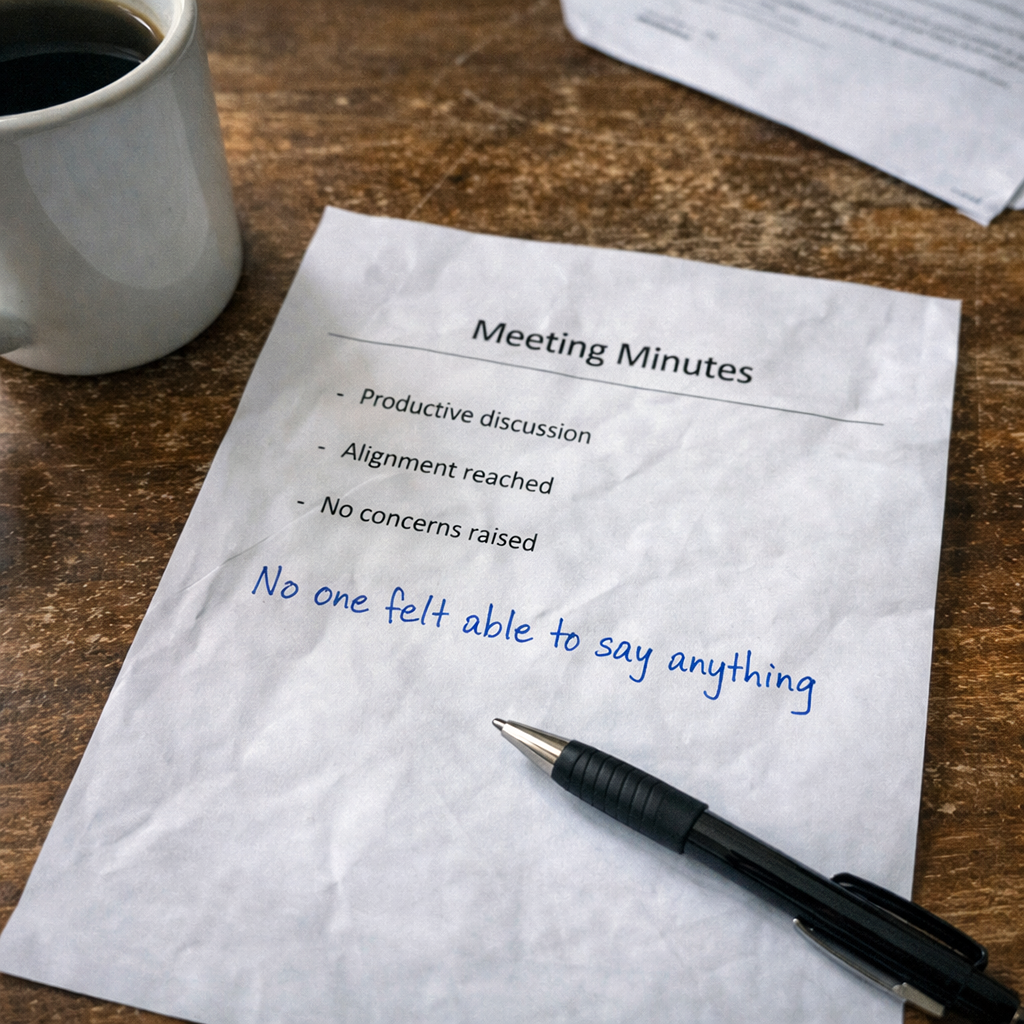
What meeting minutes don’t show
Most organisations document meetings in a consistent way:
Productive discussion
Alignment reached
No concerns raised
On paper, this suggests clarity and agreement and, in some cases, that’s accurate. But in others, the picture is more complex.
The difference between agreement and silence
In many teams, a lack of challenge isn’t always a sign of alignment.
It can reflect something else:
Uncertainty about whether it’s appropriate to challenge
Concern about how feedback will be received
Awareness of hierarchy or influence in the room
As a result, people may choose not to raise concerns in formal settings.
Where the real conversations happen
When concerns aren’t raised in meetings, they don’t necessarily disappear.
They often move elsewhere:
Informal conversations
Follow-up discussions
Private reflections
This creates a gap between:
What is recorded
And what is actually thought
Over time, this gap can influence:
Decision quality
Team dynamics
Trust within the team

Why this matters for organisations
When organisations rely solely on what is documented, they may miss important signals.
Decisions can appear well-supported, while underlying concerns remain unaddressed.
This can lead to:
Risks not being surfaced early
Repeated issues
Frustration within teams
Understanding what sits underneath
Exploring workplace culture involves looking beyond formal outputs.
It includes understanding:
How safe it feels to challenge
How decisions are discussed in practice
How influence operates within the team
These factors are often subtle - but highly influential.

Final thoughts
Meetings don’t just reflect culture.
They help shape it.
And what isn’t said in those moments can be just as important as what is.

Nicole Williams is an occupational and coaching psychologist specialising in culture repair, team dynamics and psychologically safe workplaces.
Comments